
The free AI website check
What the free AI website check measures.
The check reads your site the way AI crawlers do. It tells you whether they can reach it, how quotable your pages are out of 100, and which fixes to make first. It takes about a minute and needs no account.
The check on our own site, before and after
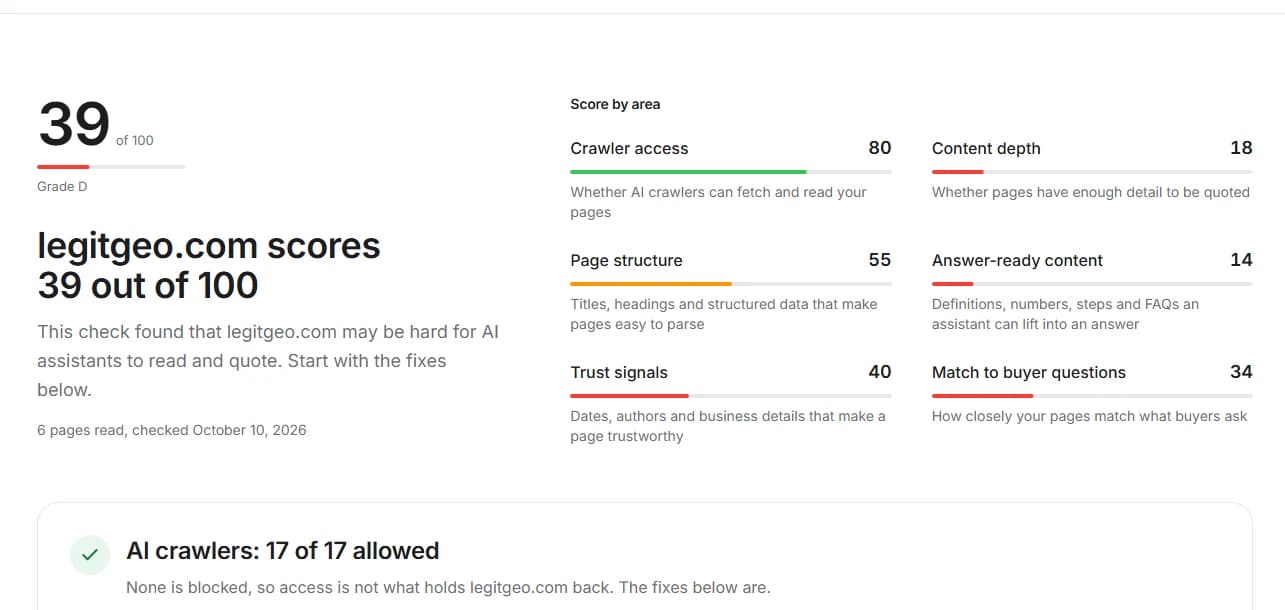
On October 10, 2026 the check gave legitgeo.com 39 out of 100, grade D, and listed a business fact sheet, structured data and a sitemap as the first fixes. 10 days later, on October 20, after we added structured data, a sitemap and fuller pages, it gave 98 out of 100, grade A.
Both results are public: October 10 and October 20. A higher readiness score means AI can read the site more easily. It does not show that any assistant recommends us; that takes tracking and a verdict.
What is AI search readiness?
AI search readiness is how easily AI assistants and search engines can reach, read and quote your website. The free check tests what AI crawlers can access on your site, scores how quotable your pages are out of 100, and ranks the fixes worth making first.
Assistants such as ChatGPT, Google AI Overviews, Perplexity and Gemini answer questions by reading public web pages. If a crawler is blocked, a page renders only with JavaScript, or the page never states the facts a customer asks about, the assistant has less to work with when it decides what to say about your business.
Readiness is the part you control. A ready site does not guarantee that any assistant will name you, and LegitGeo never promises that it will. It removes the technical and content reasons an assistant could not.
What the check scores
The check reads up to 25 public pages of your site and test-fetches your homepage as 17 AI and search crawlers. Each page is scored out of 100 points across six areas, and your site score is the average of the pages that loaded:
- Crawler access, 15 points: robots.txt rules, firewall responses, noindex tags and canonical links.
- Content depth, 15 points: how much readable text the page has. The check flags pages with fewer than 1,000 words.
- Page structure, 20 points: one clear H1 heading, H2 sections, and key points written as lists.
- Answer-ready content, 25 points: a plain definition, specific numbers, comparisons, step-by-step instructions and an FAQ.
- Trust signals, 15 points: a visible date, an author, links to outside sources, and structured data (JSON-LD).
- Match to buyer questions, 10 points: whether your titles and headings use the words customers use when they ask.
Scores map to four readiness grades. They describe how readable the site is, not what any assistant says:
- A, 80 or more: easy for AI to read and quote.
- B, 65 to 79: mostly readable, with a few gaps.
- C, 45 to 64: needs work before AI can rely on it.
- D, below 45: hard for AI to read; start with the first fixes.
Which AI crawlers the check tests
The check requests your homepage the way each crawler does and reads your robots.txt rules for it. The 17 crawlers belong to the companies behind today's main AI assistants and search engines:
- OpenAI: GPTBot, OAI-SearchBot and ChatGPT-User.
- Anthropic: ClaudeBot, Claude-SearchBot and Claude-User.
- Perplexity: PerplexityBot and Perplexity-User.
- Google: Googlebot and the Google-Extended control.
- Microsoft: Bingbot, for Bing and Microsoft Copilot.
- Apple: Applebot-Extended.
- Others: Amazonbot, meta-externalagent, DuckAssistBot, CCBot (Common Crawl) and Bytespider.
A blocked crawler is not always a mistake; some sites block training crawlers on purpose. The check shows exactly which crawler is refused, and why, so the choice is yours.
How to check your website for AI search and fix what it finds
- Run the check. Enter your website at app.legitgeo.com/check. Results arrive in about 60 seconds.
- Read crawler access first. If an AI crawler is refused, nothing else matters for that assistant until it can read the site.
- Start with the top three fixes. The list is in the order to make them. On our own site, the first three were a business fact sheet, structured data and a sitemap.
- Make the changes on your site. Most fixes are content or markup changes, not a rebuild.
- Run the check again. The new score shows whether the site is easier to read.
Whether the change moved what AI assistants say is a different question. Paid plans track the questions your customers ask every day and give each change a verdict, measured against businesses that changed nothing in the same weeks. How we prove it explains why a plain before-and-after comparison cannot answer it.
AI readiness compared with traditional SEO tools
Traditional SEO tools are built around search rankings. AI readiness asks a different question: can an assistant read your pages and quote a clear answer from them? The two overlap, and LegitGeo includes a search health crawl, but the focus differs:
| Question | Traditional SEO tool | LegitGeo |
|---|---|---|
| What is measured | Keyword rankings, backlinks, site errors | Whether AI crawlers can read the site and whether its pages can be quoted |
| Crawlers tested | Mostly the major search crawlers | 17 AI and search crawlers, one by one |
| Content checks | Titles, meta tags, keyword use | Definitions, numbers, comparisons, steps, FAQs, dates and sources |
| Ongoing tracking | Positions in search results | Which AI assistants name your business for the questions you track |
| Proof of a change | Rank before and after | A verdict against businesses that changed nothing |
Who the check is for
- Local and service businesses that want to know whether assistants can find and describe them.
- Brands with several locations or product lines, which can track up to 10 brands in one account.
- Agencies that run readiness checks and visibility tracking for their clients.
- Platforms and marketplaces that show visibility to the businesses they serve. Settlyfe, our first partner, works this way; Settlyfe Inc. also operates LegitGeo.
Plans start at $99 a month for one business, and every first subscription begins with a 14-day free trial. See pricing for the full comparison.
The free AI website check: frequently asked questions
Is the AI website check free?
Yes. Anyone can check a public website at app.legitgeo.com/check without an account. Each visitor can run 5 checks per hour.
What is GEO, or generative engine optimization?
GEO means making a website easy for generative AI assistants to read, understand and quote. It covers crawler access, page structure and answer-ready content, alongside classic SEO.
Does a high score mean ChatGPT will recommend my business?
No. The score measures how readable and quotable your website is. No one can guarantee what an AI assistant says, and LegitGeo does not claim to.
Which AI crawlers does LegitGeo test?
The check tests 17 crawlers, including GPTBot, OAI-SearchBot, ChatGPT-User, ClaudeBot, PerplexityBot, Googlebot, Google-Extended, Bingbot, Applebot-Extended and CCBot.
How long does the check take?
About a minute. It reads up to 25 public pages and test-fetches your homepage as each crawler.
Do I need to change my robots.txt file?
Only if it blocks a crawler you want to reach you. The check names each blocked crawler and the rule that blocks it, so you can decide.
What is llms.txt and do I need one?
llms.txt is a short plain-text guide to your site for AI tools, published at /llms.txt. Some tools read it, it costs little to add, and the check reports whether you have one.
How do I know whether a fix changed what AI says?
Paid plans track your questions every day and give each change a verdict, measured against businesses that changed nothing in the same weeks. A verdict arrives about a month after the change.
Sources and further reading
- OpenAI: Overview of OpenAI crawlersGPTBot, OAI-SearchBot and ChatGPT-User.
- Anthropic: How Anthropic crawls the webClaudeBot, Claude-SearchBot and Claude-User.
- Perplexity: Perplexity crawlersPerplexityBot and Perplexity-User.
- Google: Common crawlers, including Google-ExtendedGooglebot and the Google-Extended control token.
- Microsoft: Which crawlers Bing usesBingbot, which also feeds Microsoft Copilot.
- Apple: About ApplebotApplebot and Applebot-Extended.
- Common Crawl: CCBotThe open web archive many AI models are trained on.
- RFC 9309: Robots Exclusion ProtocolThe standard robots.txt rules crawlers follow.
- The llms.txt proposalA plain-text guide to a site for AI tools.
- Schema.org: Getting startedThe vocabulary behind structured data (JSON-LD).
- Sitemaps.org: Sitemap protocolHow sitemap.xml lists the pages of a site.